

FEEDBACK  |  CONTACT  |  SITE MAP  |  ABOUT US   
Ask an account
You are here : Home / Home URGI / Species / Wheat

Wheat

Wheat


No one can be a statesman who is entirely ignorant of the problems of wheat (Socrates, 470-399BC).


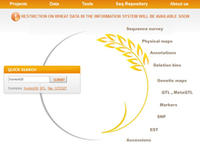
New pictogram

IWGSC Survey Sequence Repository is available.

Wheat physical map viewer v4 is available.


Why develop Wheat genomics?

Today, agriculture is facing one of its greatest challenges since it began 10 000 years ago, that of producing an ample supply of high quality food and feed for a growing world population in a sustainable and environment friendly manner. Bread wheat (Triticum aestivum L.) is the staple food for more than 35% of the people and is grown on over 95% of the wheat growing area. Its sequence holds the key to genetic improvements that will allow growers to meet the increasing demands for high quality food and feed produced in an environmentally sensitive, sustainable, and profitable manner. Further, because of its recent history, hexaploid wheat is a very good model to study polyploidy, a driving evolutionary force for more than 90% of all plants.

The International Wheat Genome Sequencing Consortium (IWGSC) , was established by a group of plant scientists, breeders, and growers dedicated to sequencing the wheat genome to enhance our knowledge of the structure and function of the wheat genome. By gaining increased understanding of the biology of agronomically important traits and deploying state-of-the-art molecular tools, plant scientists and breeders will be able to accelerate wheat improvement to meet the challenges of the 21st century. The IWGSC is committed to ensuring that the sequence of the wheat genome and the resulting DNA-based tools are available for all to use without restriction.

The European Triticeae Genomics Initiative (ETGI) is a platform for the coordination and representation of Triticeae (Wheat, barley, rye) genomics research at the European level and serves as a link to the International research community represented by the International Triticeae Mapping Initiative (ITMI). ETGI consists of European scientists from public and private research institutes who are interested in developing complementary and coordinated research projects on Triticeae genomics to pave the way for a better understanding of crop plant systems biology and, thereby, enable substantial improvements of these essential crop species for the EU and world agriculture. ETGI partners coordinate applications for national and European research and training projects to assist in strengthening and structuring of the European Research Area (ERA). For three years beginning in 2007, ETGI networking activities are supported by the COST action "Tritigen" (FA0604) .

Wheat field


INRA Clermont-Ferrand plays a major role in these initiatives both in contributing to the leadership of the two consortia and by scientific projects developed within these frameworks. The following projects are currently underway:

  • ANR:
    • ANR Genoplante 3BSeq : Sequencing, annotation and characterization of the bread wheat chromosome 3B
    • ANR2005-3B: EXEGESE-BLE: Chromosome 3B, a Model to Study the Structure, Function and Evolution of the Wheat Genome
    • ANR Genoplante 2006 SMART Project: Sequencing and Molecular Analysis of Resistance loci on chromosome Three
  • Genoscope:
    • Sequencing of Megabase-sized BAC contigs on Chromosome 3B
  • FP7 large collaborative project TriticeaeGenome (2008-2012) TriticeaeGenome, coordinated by the INRA Clermont-Ferrand is designed to achieve significant progresses in Triticeae genomics and support efficient breeding of improved varieties for the European agriculture by:
    • Constructing and anchoring physical maps from the wheat and barley group 1 and 3 chromosomes that carry a large number of important agronomic traits (e.g. disease resistance, yield and quality)
    • Isolating genes and QTLs underlying disease resistance, yield and quality traits in wheat and barley
    • Identifying and exploiting new alleles for the isolated genes through the use of natural and mutant populations as well as wild germplasm
    • Supporting the development of new varieties that meet farmer and consumer needs through molecular breeding
    • Developing new bioinformatic tools to structure, relate and comprehensively analyse the large scale genomics data gathered within the project and
    • Leading, coordinating and integrating Triticeae genomics research

These projects are developed within the framework of the competitivity cluster Cereales Vallée that supports research project in 5 areas:

  • "Plants for the Future": genetic resources; marker assisted selection
  • "Human Food Ingredients": hygiene and security of food; wheat and nutrition; agricultural practices and quality
  • "Animal Feed Ingredients": better use of feeds; improving product quality
  • " Non - Food Ingredients and Products": biodegradable plastics; industrial components
  • "Finished Products": bread making products; breakfast cereals


logo IWGSC logo ETGI logo Céréales Vallée France Agrimer

logo Tritigen logo TriticeaeGenome 3Bseq

Update: 20 Apr 2012
Creation date: 18 Mar 2010
PLATFORM   RESEARCH   PROJECTS   DATA   TOOLS   SPECIES   ABOUT US   FEEDBACK   CONTACT US   REGISTER   EDIT